
Modernism means freedom - freedom to mix, to choose, to change, to embrace the new but hold fast to what is good. - Edward Wormley
Wednesday, June 22, 2011
Picking a Fabric: Installment #1
Fabric is always a little bit tricky. A lot of times a fabric will look wonderful in a swatch but is incredibly busy in a larger quantity. A good rule for these busy patterns is to use them in small amounts. Pillows, upholstered dining chairs and the like are great for the bold stripe and awesome paisley patterns. If you are going bold on a large peice of furniture like a sofa, be careful that you love the pattern because it will be magnified. Bold moves are rewarded in design, but there is also the possiblity of epic failure. Happy designing.

Monday, June 20, 2011
Building on Neutrals
I know I've spent a lot of time talking about accessories, this is why. Accessories are very easy and relatively inexpensive to switch out and get a new look to your room. Accessories allow a room to be trendy if that is your wish, while maintaining some timeless furniture as your central pieces in the room.
Those central pieces: sofas, headboards, walls - can be painted and upholstered in vibrant colors and be beautiful. The question you have to ask yourself is if you will love it enough to keep that style for a very long time. If the answer is yes, than do it. If not, stick with neutrals.
This doesn't mean that your walls have to be white and the sofa is grey and all the wood is oak. What I am saying is let the accessories bring in the color and give the feel you are looking for in the room. If you tire of that look it is easy to switch out pillows, lamp shades, or prints on the wall.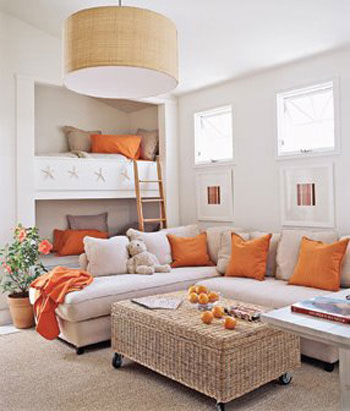

Those central pieces: sofas, headboards, walls - can be painted and upholstered in vibrant colors and be beautiful. The question you have to ask yourself is if you will love it enough to keep that style for a very long time. If the answer is yes, than do it. If not, stick with neutrals.
This doesn't mean that your walls have to be white and the sofa is grey and all the wood is oak. What I am saying is let the accessories bring in the color and give the feel you are looking for in the room. If you tire of that look it is easy to switch out pillows, lamp shades, or prints on the wall.
Sunday, June 19, 2011
It's a Pillow
I love throw pillows, I have way too many of them. So I always notice a good pillow when someone else happens to have one. I really like the bold patterns pillows can bring into a room. When I was redecorating my bedroom I was looking at throw pillows for my bed, and some of them were outrageously expensive. Come on! It's a pillow, I can make that!
For those who are less sewing inclined, I think we are in good company. I found that the solution to my miserly pillow love was already at hand. solid color pillows range from 5.00 to 20.00 depending on what kind of pillow you are looking for, the fabric type and if you are into ruffles, round pillows and other fancy fabric.
Patterned pillows are expensive, but fabric paint is not. Neither are fabric stencils, if you want to make your own stencil that's a little more work but totally doable. I've made stencils and they have turned out great. the other great thing about stencilling fabric is that painting allows for a flexibility that printing does not. I would say make sure to over paint, especially with different colored paints.
The patterns can be as intricate or basic as you like. I really enjoy the look of spencilled Fabric as well. It's a pillow, but how much more fun is it when it is your own!


For those who are less sewing inclined, I think we are in good company. I found that the solution to my miserly pillow love was already at hand. solid color pillows range from 5.00 to 20.00 depending on what kind of pillow you are looking for, the fabric type and if you are into ruffles, round pillows and other fancy fabric.
Patterned pillows are expensive, but fabric paint is not. Neither are fabric stencils, if you want to make your own stencil that's a little more work but totally doable. I've made stencils and they have turned out great. the other great thing about stencilling fabric is that painting allows for a flexibility that printing does not. I would say make sure to over paint, especially with different colored paints.
The patterns can be as intricate or basic as you like. I really enjoy the look of spencilled Fabric as well. It's a pillow, but how much more fun is it when it is your own!
Wednesday, June 15, 2011
The Ceiling
Traditionally, the ceiling was the decorated part of the room, not just some flat surface that hung over a room. I'm not saying that I don't like a white ceiling. What I am saying is that the ceiling, as well as any crown molding around the upper walls should be given some thought.
The color from the walls veing used on the molding, or spilling the color onto the ceiling can make the room seem taller. This is a great trick in basement rooms where the ceiling height can be 7 feet. I know I always feel like ducking. So while you may not want to paint the entire ceiling. consider part of it.
Conversely, if the ceiling seems too tall, bring the ceiling down the walls just a bit, or create an attic on the walls (a part of the upper wall that is decorated separately from the rest of the wall and ceiling). It will help fill the room.
The color from the walls veing used on the molding, or spilling the color onto the ceiling can make the room seem taller. This is a great trick in basement rooms where the ceiling height can be 7 feet. I know I always feel like ducking. So while you may not want to paint the entire ceiling. consider part of it.
Conversely, if the ceiling seems too tall, bring the ceiling down the walls just a bit, or create an attic on the walls (a part of the upper wall that is decorated separately from the rest of the wall and ceiling). It will help fill the room.
Friday, June 10, 2011
Color Palettes
Before I dive into color schemes I need to get a couple of terms clear. I'll use them and if they are not clear, than not much else will make sense.
If the room is too small or you are not quite set on the foresty look for your room, but still want to incorporate emerald green, accessorize in green, paint in neutral or consider the following:
A color scheme is any set of colors that work together to create a visually appealing layout. The following are suggested combinations, but the possible combinations are limitless.

Complementary Colors
Complementary colors are located opposite each other on the color wheel; for example - red and green, yellow and violet. Each color brings out the richness in the other. When using complementary colors, one color should be subtle and the other color should be more dominant. For example, an intense, dark violet should be paired with a medium to light yellow.
Split Complementary Colors
Split complementary colors offer a wild and daring color palette. Select a main color. Next, find the complementary color and select colors from each side of the complementary color. These colors are excellent for using when layering a faux finish.

Related Colors
Related colors are located next to each other on the color wheel. These colors produce a less contrasting effect than complementary colors. For example, a dark blue-green combined with a light blue can give the feeling of floating in a blue lagoon.

Monochromatic Colors
Monochromatic colors are colors with the same hue but different tones, values and saturation. For example, a paint swatch card has several different values of one color. Using two or more monochromatic colors creates a stylish and pleasant look.
There are more color schemes to be considered but this is a good start. Remember to consider Values Tones and Saturation when bringing a color scheme together. They do not have to be the same, but it is important that they match. Happy Designing!
- The hue of a color is the basic color. For example, blue is the hue in light blue and dark blue.
- Tone describes the color's density and reflective quality. Tone is important when choosing a color scheme.
- The value of a color describes the amount of white or black in the color. The value ranges from light to dark on a gray scale.
- The saturation of a color refers to its pureness and boldness.
If the room is too small or you are not quite set on the foresty look for your room, but still want to incorporate emerald green, accessorize in green, paint in neutral or consider the following:
A color scheme is any set of colors that work together to create a visually appealing layout. The following are suggested combinations, but the possible combinations are limitless.
Complementary Colors
Complementary colors are located opposite each other on the color wheel; for example - red and green, yellow and violet. Each color brings out the richness in the other. When using complementary colors, one color should be subtle and the other color should be more dominant. For example, an intense, dark violet should be paired with a medium to light yellow.
Split Complementary Colors
Split complementary colors offer a wild and daring color palette. Select a main color. Next, find the complementary color and select colors from each side of the complementary color. These colors are excellent for using when layering a faux finish.
Related Colors
Related colors are located next to each other on the color wheel. These colors produce a less contrasting effect than complementary colors. For example, a dark blue-green combined with a light blue can give the feeling of floating in a blue lagoon.
Monochromatic Colors
Monochromatic colors are colors with the same hue but different tones, values and saturation. For example, a paint swatch card has several different values of one color. Using two or more monochromatic colors creates a stylish and pleasant look.
There are more color schemes to be considered but this is a good start. Remember to consider Values Tones and Saturation when bringing a color scheme together. They do not have to be the same, but it is important that they match. Happy Designing!
Thursday, June 9, 2011
To All My Loyal Readers
I know you're out there! Thank you so much for taking the time to read my blog, I hope you've been enjoying reading it as much as I have been enjoying writing about design. I will be out of town this weekend, and won't have access to a computer. I will make sure that there is a great entry tomorrow, but I won't be able to write again until next Tuesday.
As far as I'm concerned we've only just begun. I'll be back with all sorts of new ideas to share. If you have any questions let me know, I'd love to answer them.
As far as I'm concerned we've only just begun. I'll be back with all sorts of new ideas to share. If you have any questions let me know, I'd love to answer them.
Making the Most of a Small Room
Small rooms present their own special set of challenges when trying to design a functional space. I've seen that challenge lead to some of the best and worst designed rooms I've seen. Entire industries have been built around space saving furniture and equipment to varying degrees of practicality and functionality. With a few tips, planning, and a some creativity, small spaces can be some of the most interesting and coziest places in a home.
1. Increase floor space in a small room by removing unnecessary pieces of furniture. Remember, the main function of a room and allow that function to dictate the largest piece of furniture in the room.
2. Use furniture with feet that will show the floor below the furniture. This will visually increase the floor space of the room.
3. Get as many items off the floor as possible. If you want to keep them in the room, reposition them on shelves and pieces of furniture instead of on the floor.
4. Increase usable space by removing clutter, leave just a few (1-3) of any one type décor room accessory; such as magazines displayed on an end table, vases, throw pillows, etc.
5. Consider the use and choice of decor on wall space wisely. Too many objects and too many prints will make the room appear smaller, stuffy, and closed in; instead of open, airy, and relaxing. Although using wall space can be helpful for creating more floor space, too many things on the wall will make the room appear overcrowded and smaller.
6. Mirror, Mirror on the Wall..... A decorative mirror, especially a large wall mirror, will act as a room expander when strategically placed to reflect light or an attractive element in the room. Such as a window with a scenic view, a doorway into another room, a fireplace, or artwork. A lighted mirror will add warmth and depth to a small room with otherwise subdued lighting. A large mirror on the long wall of a narrow room will make the room appear wider.
7. Continue a single color theme between two continuous rooms. If this is not possible, another color idea for small rooms is to add depth using solid colors. Using one color for the wall of one room, and another for the door opening and walls in the next room will accentuate and define the space.
8. Avoid patterned wallpaper and dark colors; both have the tendency to overpower small spaces. Neutral, light shades and bright colors work best.
9. Make use of corner spaces for entertainment centers, china hutches, and book cases. Floor to ceiling built in book cases and shelves are great space savers and look amazing.
10. Consider how small the space you are working with actually is. Small apartment furniture is down-sized; attractively designed specifically for limited spaces. Some have an ingenious collapsible space saving design; others have hidden space saving storage, fit in a corner, or are simply smaller versions of standard-sized furniture.
There's something for everyone, you just have to start looking. Happy Designing!
1. Increase floor space in a small room by removing unnecessary pieces of furniture. Remember, the main function of a room and allow that function to dictate the largest piece of furniture in the room.
2. Use furniture with feet that will show the floor below the furniture. This will visually increase the floor space of the room.
3. Get as many items off the floor as possible. If you want to keep them in the room, reposition them on shelves and pieces of furniture instead of on the floor.
4. Increase usable space by removing clutter, leave just a few (1-3) of any one type décor room accessory; such as magazines displayed on an end table, vases, throw pillows, etc.
5. Consider the use and choice of decor on wall space wisely. Too many objects and too many prints will make the room appear smaller, stuffy, and closed in; instead of open, airy, and relaxing. Although using wall space can be helpful for creating more floor space, too many things on the wall will make the room appear overcrowded and smaller.
6. Mirror, Mirror on the Wall..... A decorative mirror, especially a large wall mirror, will act as a room expander when strategically placed to reflect light or an attractive element in the room. Such as a window with a scenic view, a doorway into another room, a fireplace, or artwork. A lighted mirror will add warmth and depth to a small room with otherwise subdued lighting. A large mirror on the long wall of a narrow room will make the room appear wider.
7. Continue a single color theme between two continuous rooms. If this is not possible, another color idea for small rooms is to add depth using solid colors. Using one color for the wall of one room, and another for the door opening and walls in the next room will accentuate and define the space.
8. Avoid patterned wallpaper and dark colors; both have the tendency to overpower small spaces. Neutral, light shades and bright colors work best.
9. Make use of corner spaces for entertainment centers, china hutches, and book cases. Floor to ceiling built in book cases and shelves are great space savers and look amazing.
10. Consider how small the space you are working with actually is. Small apartment furniture is down-sized; attractively designed specifically for limited spaces. Some have an ingenious collapsible space saving design; others have hidden space saving storage, fit in a corner, or are simply smaller versions of standard-sized furniture.
There's something for everyone, you just have to start looking. Happy Designing!
Wednesday, June 8, 2011
It's Not Easy Being Green
Has anyone else noticed the love affair with that ugly flourescent green color that's telling the world to "Go Green!" You would think of all the greens there were to pick from, they could have found one that was less annoying. Because I'm all about saving Polar Bears, but that poster almost makes me want to punch one and see how I fare.
In any case, whether you're a polar bear or penguin fan, going green can be tough on the wallet, at least up front. This is especially true if you are wanting to go all out with geothermal or solar power, convection heated floors, and and all sustainable materials. But doing your part to be environmentally conscious doesn't have to be extreme, or extremely expensive.
First, let's discuss sustainable materials. Can the material being be naturally replaced? Bamboo is awesome. Versatile, strong, and beautiful, this grass's lifecycle is 28 years. It will replace itself very quickly and provides a thriving industry in East Asia. It also satisfies my next question. Can the product be efficiently harvested, quarried, and shipped to its final destination? How long will the product last? Can the material be reused once its original purpose is complete? More important, can old material be used instead of new material? If old material can be used there is the possibitlity for a look that would be very labor intensive to achieve in new matierial.
Salvaged material is amazing. There is an entire industry that pulls sunken logs off the bottom of the Mississippi River and other large shipping thoroughfares, dries them out and uses them for furniture and accents in homes and office buildings. The amazing part about this is that the logs being pulled up from the bottom of the river are much larger than the trees growing around the area today. Being settled on the bottom of the river changes the logs, even when dried out, the preserved logs are aged. Obviously this is an expensive process, resulting in an expensive product. Something less expensive. My grandma was pulling down her barn and needed a picture frame, she needed some wood for her picture frame, she used the wood from the barn for the picture frame. I love that picture frame.
Try looking at old things it new ways, how can I use this instead of just tossing it aside. If there isn't a way to use it, recycle it. It's really quite easy being green, you just have to find one that suits you.
In any case, whether you're a polar bear or penguin fan, going green can be tough on the wallet, at least up front. This is especially true if you are wanting to go all out with geothermal or solar power, convection heated floors, and and all sustainable materials. But doing your part to be environmentally conscious doesn't have to be extreme, or extremely expensive.
First, let's discuss sustainable materials. Can the material being be naturally replaced? Bamboo is awesome. Versatile, strong, and beautiful, this grass's lifecycle is 28 years. It will replace itself very quickly and provides a thriving industry in East Asia. It also satisfies my next question. Can the product be efficiently harvested, quarried, and shipped to its final destination? How long will the product last? Can the material be reused once its original purpose is complete? More important, can old material be used instead of new material? If old material can be used there is the possibitlity for a look that would be very labor intensive to achieve in new matierial.
 |
| Designer Trevor O'Neil used salvaged cork to create this modern sofa. Thanks to Treehugger.com for the picture. |
Try looking at old things it new ways, how can I use this instead of just tossing it aside. If there isn't a way to use it, recycle it. It's really quite easy being green, you just have to find one that suits you.
Tuesday, June 7, 2011
Accessorize
I have been doing a lot of remodeling lately. It's been good to keep busy. This is some pictures from my room. Since I am focusing on the accessories, I'll give a little background. The walls are a cool gray the trim is a very light blue to combat the feeling of being in a lavender room. I didn't want a blue room or a purple room, I wanted a gray room. I was pretty nervous when the paint was 3/4 of the way dry, it was looking grayish purple, but it's gray now. Accent colors include that pretty, almost white - blue, champagne orange, rust, orchid and purple.
I haven't been following any specific style for my room on this one, I'm going a little Modern French meets Art Nouveau. I have a classic art nouveau porcelain figurine that I paired with a French shoe box. At first I wondered if these two styles would mix well, they seem to be on good terms so far. But I cannot say that I have stayed with these two styles alone.
I love natural wood. So when I found this bird house, I thought for a long time if I could make it work. I did have natural wood in my room so that would be ok, it needed more whimsy. Birds. I needed to add birds. That's easy, and I had a shelf that needed something on it so I had a place for it. All I had to do was get some birds and I was set.
I think that the hardest part about accessorizing is knowing when to stop. I am always finding cute things to put somewhere but then I am left with a cluttered mess. I also love to make my accessories, I love to arrange flowers and paint pictures, but accessories, like everything else in a room have to be planned. More isn't necessarily better, a lot of the time it's worse.
If you do want to change accessories, that's great, do it. but change them. Take things out. When designing a room keep large objects neutral. Use those accessories to add the character to the room and you'll have a new room every few years if you want it to be so.
 |
| Dresser Top and Painting |
 |
| A detail of the side table/vanity |
 |
| I found a random bird house that I thought was beautiful and just went from there, the fan is from the Philippines. |
I think that the hardest part about accessorizing is knowing when to stop. I am always finding cute things to put somewhere but then I am left with a cluttered mess. I also love to make my accessories, I love to arrange flowers and paint pictures, but accessories, like everything else in a room have to be planned. More isn't necessarily better, a lot of the time it's worse.
If you do want to change accessories, that's great, do it. but change them. Take things out. When designing a room keep large objects neutral. Use those accessories to add the character to the room and you'll have a new room every few years if you want it to be so.
Monday, June 6, 2011
There's just something about old furniture.
I guess I'm still considering designing on a budget and finding unique styles. I'm a build it and/or fix it kind of girl, so I absolutely love consignment stores were someone has fixed it for me and it's old so I don't have to worry about that first scratch.
When older people break out the cliche "things just aren't like they used to be" I am pretty sure they are referring to one of two things, the internet and furniture. The internet is definately better and furniture, unless you are willing to pay a lot of money, unfortunately, has become somewhat lacking. That's not to say Ikea isn't awesome (who doesn't love Ikea?) but the you're not going to be finding Ikea furniture at a consignment store in 50 years and feel like you found a treasure. I love old furniture, it's sturdy.
Consignment adds that one of a kind interest to a room that is just so wonderful. It definately didn't come from a catalog. "Where did you get it? I want one!" I can't keep a secret I'll just tell anyone where I got something. Home Again, The Black Goose, Good Buy Consignment... When I go to these places I get to say "Too Bad!" Unless you want to go searching for a similar thing in consignment stores and flea markets this is (usually) the only one.
With consignment stores there is some patience required, new things come in all the time, if you are looking for something and it isn't there don't be discouraged, keep looking. The right piece comes in if you are flexible.
When older people break out the cliche "things just aren't like they used to be" I am pretty sure they are referring to one of two things, the internet and furniture. The internet is definately better and furniture, unless you are willing to pay a lot of money, unfortunately, has become somewhat lacking. That's not to say Ikea isn't awesome (who doesn't love Ikea?) but the you're not going to be finding Ikea furniture at a consignment store in 50 years and feel like you found a treasure. I love old furniture, it's sturdy.
Consignment adds that one of a kind interest to a room that is just so wonderful. It definately didn't come from a catalog. "Where did you get it? I want one!" I can't keep a secret I'll just tell anyone where I got something. Home Again, The Black Goose, Good Buy Consignment... When I go to these places I get to say "Too Bad!" Unless you want to go searching for a similar thing in consignment stores and flea markets this is (usually) the only one.
With consignment stores there is some patience required, new things come in all the time, if you are looking for something and it isn't there don't be discouraged, keep looking. The right piece comes in if you are flexible.
Sunday, June 5, 2011
Photos of Play Room
 This is a French Message Board that I made for my parents play room, it's 3' x 5' and will be used for holding all the art projects that the grandkids give my mom. The ribbon and the buttons were new, everything else was things that we already had.
  This is a detail of that same message board.
 Three of the four walls are painted with polka dots. We already had all of the colors that were used. We bought the stencil to make sure that the polka dots were a uniform size. The shelf, a few smaller shelves an a book case were repainted to match the room. All the decor for the shelves were repurposed. A new rug and stools were purchased. Instead of costly built in shelves, built on shelves were used.
 Designing the Taj Mahal on a Motel 6 Budget
I believe that anyone can design. I know that puts my job security somewhere around, well nothing, but fortunately this is my first post so hopely most people who follow this blog won't every read post number one. In which i claim, everyone is creative and can design. All anyone needs is money, will an unlimitied supply of funds, anyone can design.
The key to being a good designer is designing on a budget. Hardest thing I have to do is figure out how to do what I want with no money. This past weekend my parents and I redid a room in their basement for less than 100.00 dollors. It's adorable. It was a lot of work. It kind of sucked, but the room is so cute, I think it would have been difficult to find someone to pay to do the work that we did ourselves. It brings me to todays list of things to consider.
1. When money's tight, do it yourself, it may take some extra time to get it right, but you'll save a lot of money doing it yourself.
2. Consider what you have and how it can be reused, refurbushed and/or repurposed. If you don't have to buy something new, than don't.
3. Paint, it is any easy and inexpensive way to change the entire nature of a room. It's a big difference to the room without making a huge difference in your pocket book. If the paint is your largest expense your doing well.
4. While we are speaking about paint. Choose wisely, make sure to use the light boxes at the store. If you're still not sure about the color get a small paint sample at the store, better to paint over s little bit of paint on one wall than paint the entire room over again.
5. Make sure to save money for accessories and hold on to those accessories that you love. Work them into your new room. Accessories personalize a room, but don't overdo it.
6. More is not always better, learn how to say no and that's enough.
7. You're not honoring the memory of your great great uncle by keeping that old shoe horn in the closet. You know what to do, either display it or get rid of it. Some of those old family hierlooms are tragically locked away when they could be displayed.
8. If you want custom, build it yourself.
No I don't have 10. Just remember, reuse, repurpose and be creative. Decorating is about making a space functional and pleasant to be in. If you achieve those two aims than you have been successful. Happy designing.
The key to being a good designer is designing on a budget. Hardest thing I have to do is figure out how to do what I want with no money. This past weekend my parents and I redid a room in their basement for less than 100.00 dollors. It's adorable. It was a lot of work. It kind of sucked, but the room is so cute, I think it would have been difficult to find someone to pay to do the work that we did ourselves. It brings me to todays list of things to consider.
1. When money's tight, do it yourself, it may take some extra time to get it right, but you'll save a lot of money doing it yourself.
2. Consider what you have and how it can be reused, refurbushed and/or repurposed. If you don't have to buy something new, than don't.
3. Paint, it is any easy and inexpensive way to change the entire nature of a room. It's a big difference to the room without making a huge difference in your pocket book. If the paint is your largest expense your doing well.
4. While we are speaking about paint. Choose wisely, make sure to use the light boxes at the store. If you're still not sure about the color get a small paint sample at the store, better to paint over s little bit of paint on one wall than paint the entire room over again.
5. Make sure to save money for accessories and hold on to those accessories that you love. Work them into your new room. Accessories personalize a room, but don't overdo it.
6. More is not always better, learn how to say no and that's enough.
7. You're not honoring the memory of your great great uncle by keeping that old shoe horn in the closet. You know what to do, either display it or get rid of it. Some of those old family hierlooms are tragically locked away when they could be displayed.
8. If you want custom, build it yourself.
No I don't have 10. Just remember, reuse, repurpose and be creative. Decorating is about making a space functional and pleasant to be in. If you achieve those two aims than you have been successful. Happy designing.
Subscribe to:
Comments (Atom)